When your partner drinks too much: how to help without losing yourself
You can’t force a loved one to stop drinking, but research shows family members have more influence than they think. Here’s what works — and how to protect yourself and your kids.
You can’t control your partner’s drinking, but you can influence it. An approach called CRAFT (Community Reinforcement and Family Training) teaches family members to reward sober behavior, step back from rescuing and invite treatment at the right moments — and in studies it helped about two-thirds of reluctant loved ones enter treatment. Protecting your own well-being and your children’s safety matters just as much.
- Confrontational “interventions” and nagging usually don’t work.
- CRAFT gets more treatment-refusing loved ones into treatment than other approaches.
- Heavy drinking in a family is linked to conflict, violence and children’s distress.
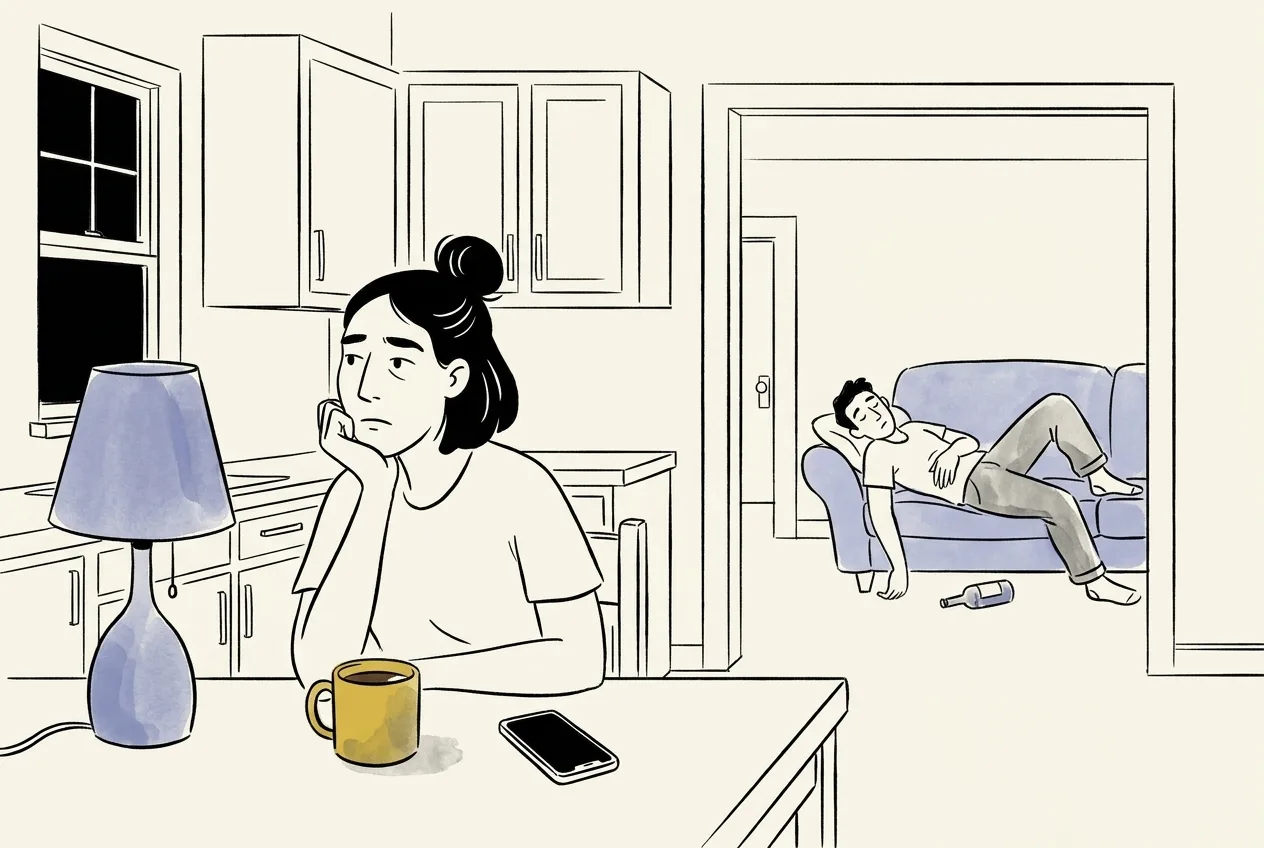
He promised he’d cut back. Then came another night of “just a few beers” that ended in a fight. You might be pouring out bottles, making excuses to his boss or lying awake waiting for him to come home. You’re not alone, and there are approaches that work.
How drinking affects the whole family
Kenneth Leonard and Rina Eiden reviewed research on alcohol use and family life 2. Heavy drinking is linked to more marital conflict, lower satisfaction, more aggression and violence, and more emotional and behavioral problems in children.
What works: CRAFT
Hendrik Roozen and colleagues analyzed studies of Community Reinforcement and Family Training (CRAFT) 1. CRAFT teaches family members to:
- Reward sober time. Do enjoyable things together when your partner isn’t drinking.
- Let natural consequences happen. Stop covering up, cleaning up or calling in sick for them.
- Communicate positively. Use “I” statements instead of blame.
- Pick the right moment. Suggest treatment when they’re sober and regretful, not mid-argument.
- Take care of yourself and stay safe.
In these studies, CRAFT helped about two in three treatment-refusing loved ones start treatment — more than confrontational interventions or Al-Anon-style support alone.
What doesn’t work
- Nagging, lecturing and pouring out bottles.
- Surprise confrontations like on TV.
- Covering for them, which removes the consequences.
Protect yourself and your kids
- Safety first. If drinking comes with threats or violence, call 911 or the National Domestic Violence Hotline (1-800-799-7233).
- Talk to your kids in age-appropriate ways: “Dad has a sickness called addiction. It’s not your fault.”
- Get support for you: a therapist trained in CRAFT, Al-Anon or SMART Recovery Family & Friends.
- Find treatment: the SAMHSA National Helpline (1-800-662-4357) and FindTreatment.gov are free and confidential.
You didn’t cause the drinking, you can’t cure it alone, and you deserve support too.
Frequently asked questions
Should I give an ultimatum?
Only if you’re ready to follow through. Threats you don’t keep teach that your words don’t matter. A clear, calm boundary works better than a heated ultimatum.
Is Al-Anon helpful?
Many people find support in Al-Anon. CRAFT is more focused on getting your loved one into treatment; the two can complement each other.
Sources
- Roozen, H. G., de Waart, R., & van der Kroft, P. (2010). Community reinforcement and family training: An effective option to engage treatment-resistant substance-abusing individuals in treatment. Addiction, 105(10), 1729–1738. doi:10.1111/j.1360-0443.2010.03016.x
- Leonard, K. E., & Eiden, R. D. (2007). Marital and family processes in the context of alcohol use and alcohol disorders. Annual Review of Clinical Psychology, 3, 285–310. doi:10.1146/annurev.clinpsy.3.022806.091424
Evidence-based · Human-centered · Practical — how we write and fact-check our articles.
This article is for educational purposes and does not replace advice from a licensed professional. We cite original research and update articles when new evidence appears. Spotted an error? Let us know — see our editorial policy.
If you or someone you love is in crisis, call or text 988 (Suicide & Crisis Lifeline). Veterans: dial 988, then press 1.