How to praise your child the right way
“You’re so smart” can backfire. Research by Carol Dweck and others shows which kinds of praise build motivation and resilience — and which undermine them.
Praise for effort and strategy (“You kept trying different ways!”) builds motivation and resilience, while praise for being smart can make kids avoid challenges and fall apart after failure. Over-the-top praise can also backfire, especially for kids with low self-esteem. The most helpful praise is specific, sincere and focused on what the child did.
- Praising intelligence can make kids fear failure and avoid challenges.
- Praising effort and strategy helps kids persist after setbacks.
- Inflated praise can make kids with low self-esteem shy away from challenges.
“You’re so smart!” It feels like the most natural thing to say to a child who just aced a spelling test. But research suggests it may not have the effect we hope for.
The famous experiments
Claudia Mueller and Carol Dweck ran a series of experiments with fifth graders 1. Children solved a set of puzzles and were praised either for their intelligence (“You must be smart at this”) or for their effort (“You must have worked hard”).
Then came a set of much harder puzzles. Children praised for intelligence:
- were more likely to choose easy tasks afterward to keep looking smart;
- enjoyed the task less and gave up sooner after failing;
- performed worse on a final set of problems;
- were more likely to misrepresent their scores.
Children praised for effort sought out challenges and bounced back from failure. This research became a foundation for the idea of a growth mindset.
When praise is too much
Eddie Brummelman, Sander Thomaes and colleagues tested inflated praise — “That’s not just beautiful, that’s incredibly beautiful!” 2. For children with low self-esteem, inflated praise made them avoid challenges afterward, perhaps because they felt they had to live up to an impossible standard. Children with high self-esteem, by contrast, sought out challenges after the same praise.
How to praise well
- Be specific: “You used three different colors for the sky.”
- Praise the process: effort, strategy, persistence, improvement.
- Be sincere, not over the top.
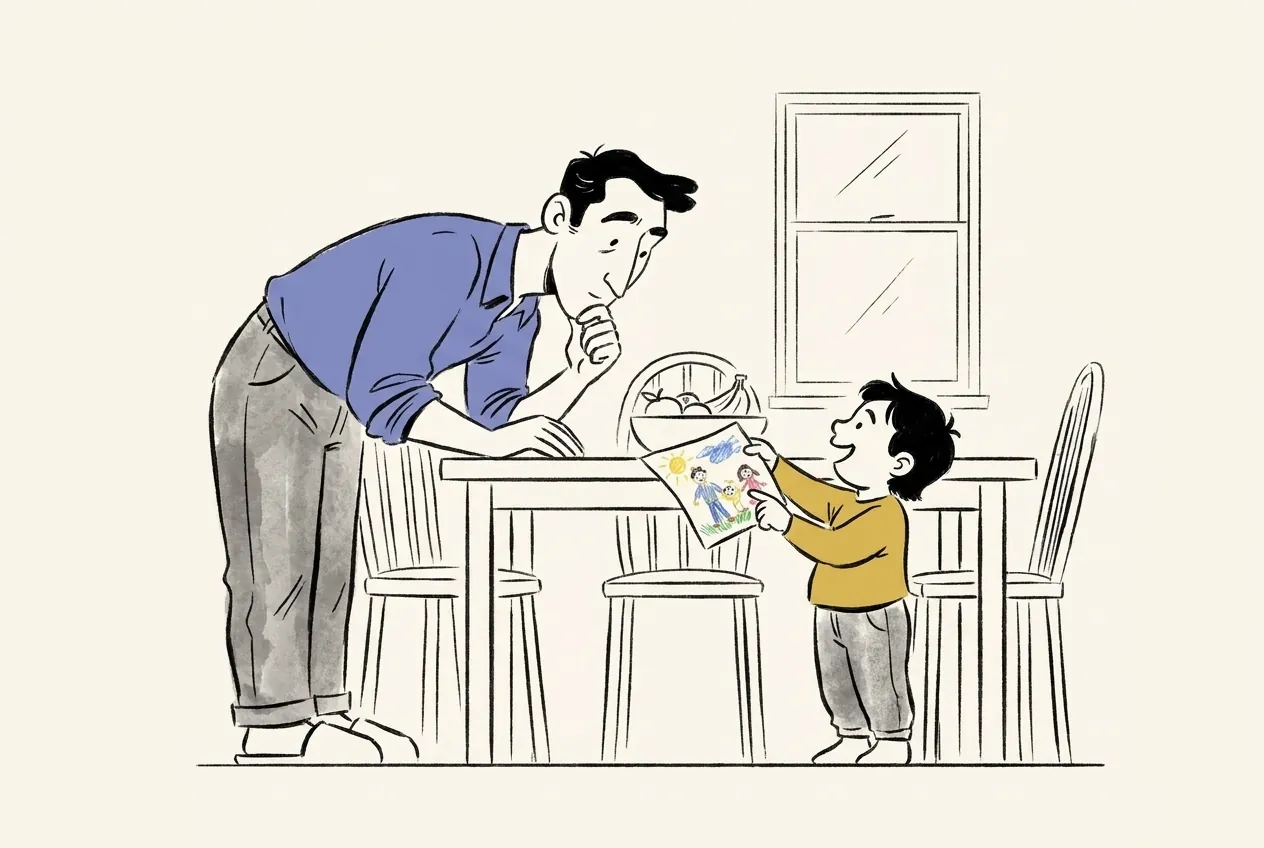
- Describe what you see and let your child evaluate their own work: “Tell me about your drawing.”
- Praise kindness and character: “You noticed your friend was sad and sat with her.”
- Avoid comparisons: “Better than your brother” teaches competition, not growth.
What to say after a failure
“That was a tough one. What could you try next time?” helps kids see setbacks as part of learning, not proof that they’re “not good at it.”
Frequently asked questions
Is it bad to say “Good job”?
Not bad, just vague. Adding one specific detail — “Good job sticking with that puzzle” — makes it much more useful.
Should I praise effort even when the result is poor?
Praise real effort and good strategies, but be honest. If a strategy didn’t work, help your child think about what to try next.
Sources
- Mueller, C. M., & Dweck, C. S. (1998). Praise for intelligence can undermine children's motivation and performance. Journal of Personality and Social Psychology, 75(1), 33–52. doi:10.1037/0022-3514.75.1.33
- Brummelman, E., Thomaes, S., Orobio de Castro, B., Overbeek, G. та ін. (2014). “That’s Not Just Beautiful—That’s Incredibly Beautiful!”. Psychological Science, 25(3), 728–735. doi:10.1177/0956797613514251
Evidence-based · Human-centered · Practical — how we write and fact-check our articles.
This article is for educational purposes and does not replace advice from a licensed professional. We cite original research and update articles when new evidence appears. Spotted an error? Let us know — see our editorial policy.
If you or someone you love is in crisis, call or text 988 (Suicide & Crisis Lifeline). Veterans: dial 988, then press 1.