How to talk with your kids about a parent’s deployment
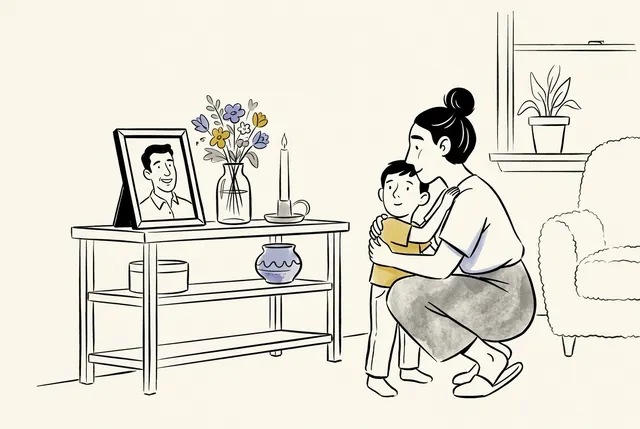
A parent’s deployment shakes a child’s world. Research on military kids shows what helps them cope — and how to talk about it at every age.
Children of deployed parents are more likely to have emotional and behavioral difficulties, especially during long or repeated deployments and when the parent at home is struggling. Honest, age-appropriate conversations, stable routines, ways to stay connected and support for the at-home parent all help children cope.
- Longer and repeated deployments are linked to more difficulties for kids.
- The at-home parent’s well-being is one of the strongest predictors of how children cope.
- Honest, simple explanations work better than secrecy.
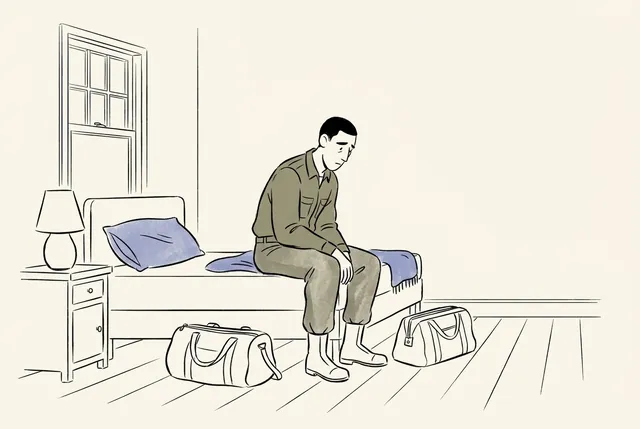
A deployment changes everything at home: who drives to practice, who’s at the dinner table, who tucks the kids in. For children, it can bring confusion, worry and anger. Here’s what research shows and how to talk with them.
What research shows
Anita Chandra and colleagues at RAND studied more than 1,500 children aged 11 to 17 from military families 1. These children reported more emotional difficulties than children in national samples. Difficulties were greater with longer total deployment time and when the at-home caregiver reported poorer mental health.
Patricia Lester and colleagues studied children whose parents had deployed to combat zones 2. The more months a parent had been deployed, the more depression and behavior problems children showed. The at-home parent’s distress was also strongly linked to children’s problems.
The message for families: kids can cope well, and supporting the parent at home is one of the best ways to support the kids.
How to talk about it, by age
- Toddlers and preschoolers: Keep it short and concrete. “Daddy is going away for work for a long time. He loves you. I’m staying with you.” Use a calendar with stickers or a paper chain to count time.
- School-age kids: Answer questions honestly and simply. Let them help pack a care package. Reassure them about who will take care of them.
- Teens: Talk more openly about risks and feelings. Ask for help, but don’t make them the “man” or “woman” of the house.
Before, during and after
- Before: tell kids a few weeks ahead, record bedtime stories, take photos together.
- During: keep routines, schedule calls when possible, let kids express feelings through drawing or journaling. Expect ups and downs.
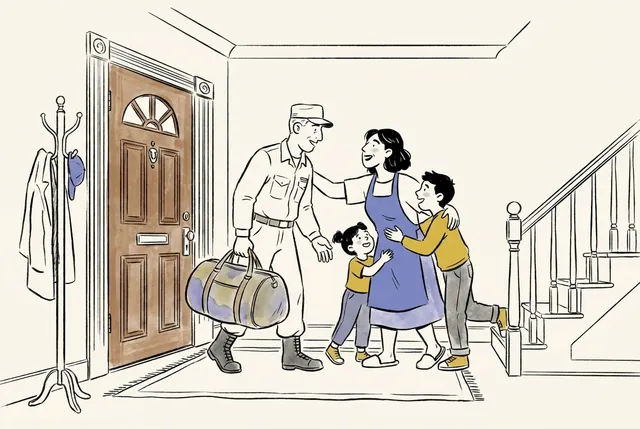
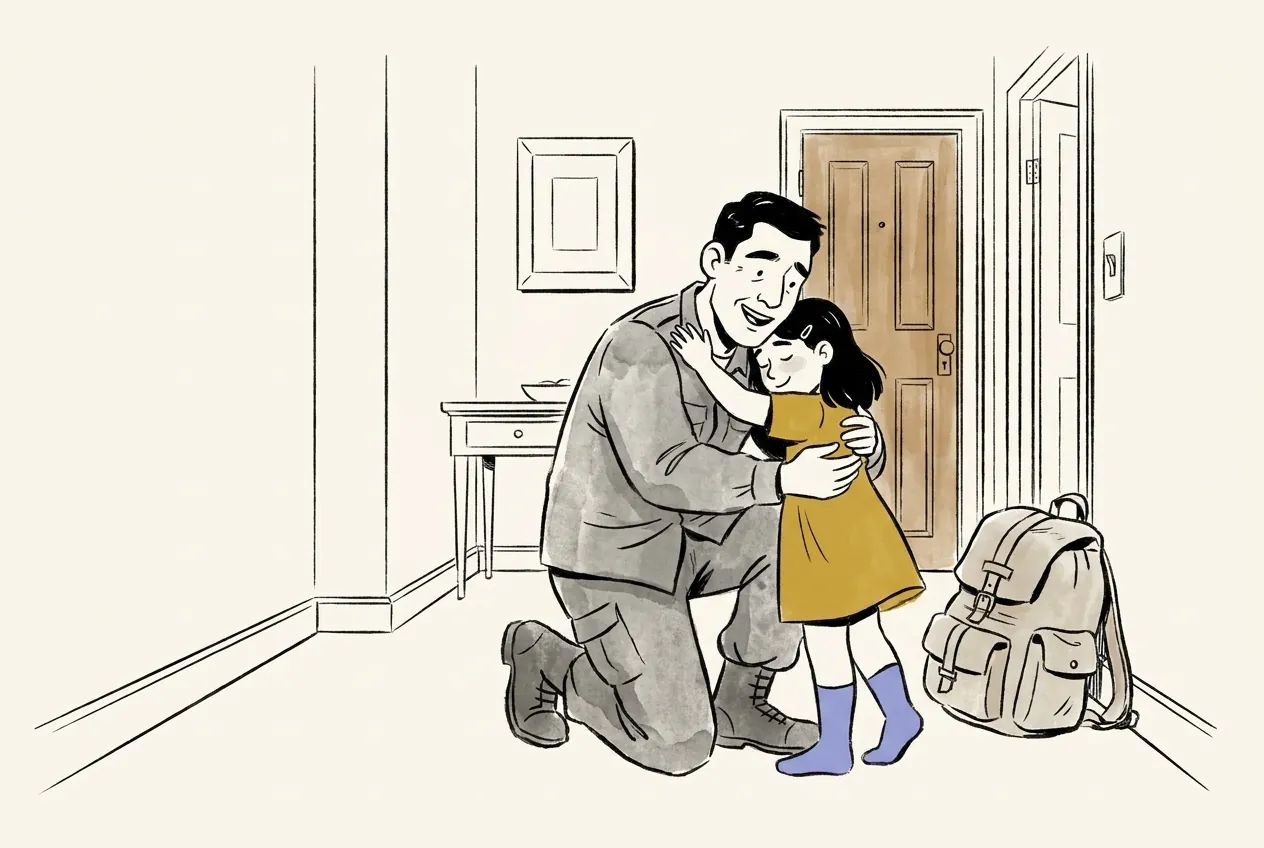
- After: prepare kids for reunion and for changes — see Homecoming after deployment.
Resources
- Military OneSource (800-342-9647): free counseling and deployment resources.
- Military and Family Life Counselors (MFLCs) on many installations and in schools.
- Sesame Street for Military Families has free videos and activities for young kids.
- Your child’s school counselor — let the school know about the deployment.
And for the at-home parent: take care of yourself. Your well-being is part of your kids’ resilience.
Frequently asked questions
Should I tell my child where their parent is going?
Share what’s appropriate for their age and for operational security: “Mom is going to work far away with her unit for about nine months.” Avoid scary details.
My child is acting out since the deployment started. Is that normal?
Changes in sleep, behavior and mood are common. Keep routines steady, stay patient and reach out to the school counselor, Military OneSource or a Military and Family Life Counselor if it continues.
Sources
- Chandra, A., Lara-Cinisomo, S., Jaycox, L. H., Tanielian, T. та ін. (2010). Children on the Homefront: The Experience of Children From Military Families. Pediatrics, 125(1), 16–25. doi:10.1542/peds.2009-1180
- Lester, P., Peterson, K., Reeves, J., Knauss, L. та ін. (2010). The Long War and Parental Combat Deployment: Effects on Military Children and At-Home Spouses. Journal of the American Academy of Child & Adolescent Psychiatry, 49(4), 310–320. doi:10.1016/j.jaac.2010.01.003
Evidence-based · Human-centered · Practical — how we write and fact-check our articles.
This article is for educational purposes and does not replace advice from a licensed professional. We cite original research and update articles when new evidence appears. Spotted an error? Let us know — see our editorial policy.
If you or someone you love is in crisis, call or text 988 (Suicide & Crisis Lifeline). Veterans: dial 988, then press 1.